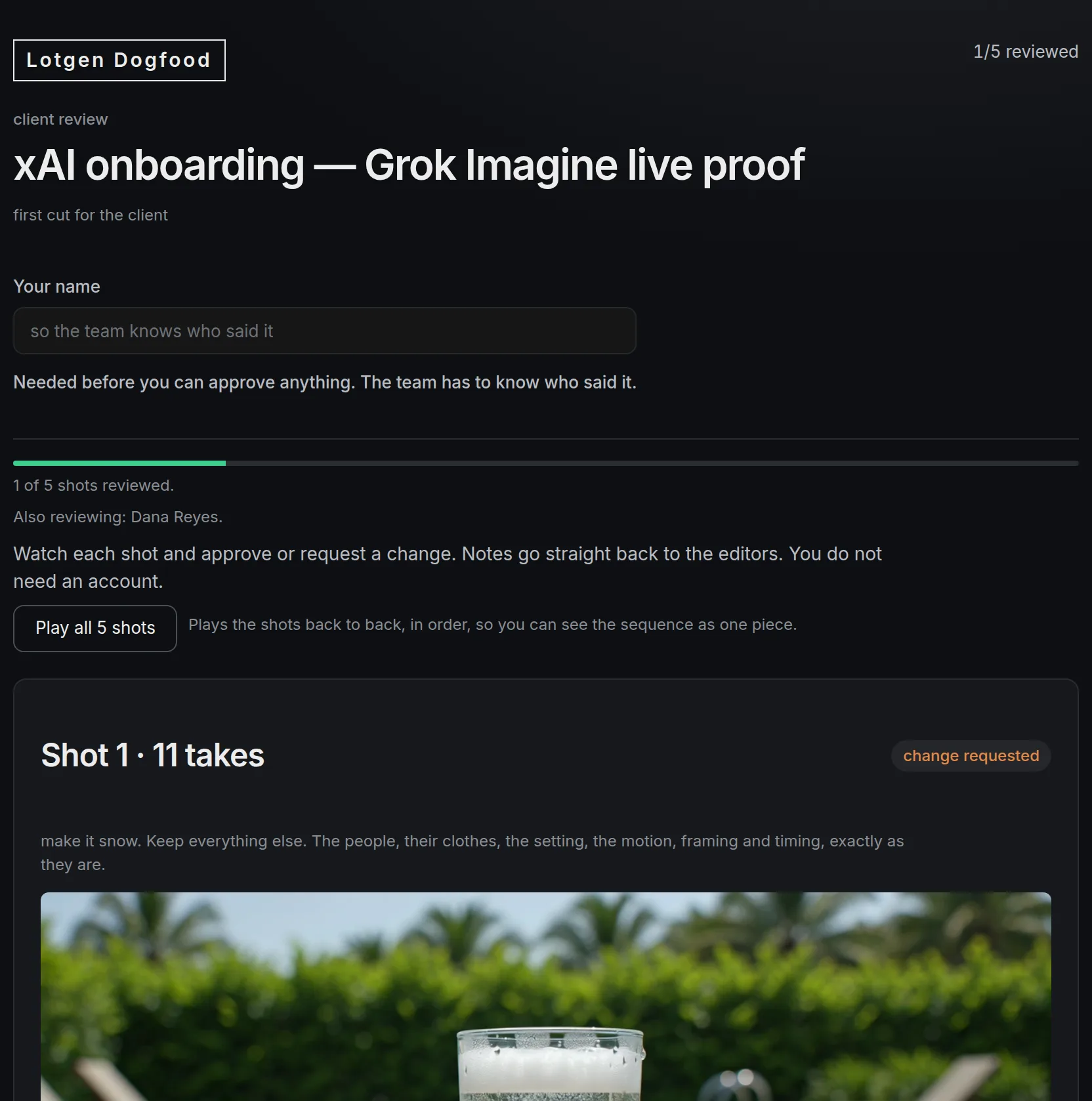
A review link is a public URL that shows one lot. No login, no account, no app to install, you send it and they watch it and say what they think.
It is public, and that is the design.
Anyone the link is forwarded to can watch it and cast a verdict. The room is whoever holds the token. That is what makes it usable, a client can forward it to their own colleague without asking you for anything, and it is the thing to know before you send it, not after.
Give it an expiry. A link with none outlives the campaign it was made for, and the campaign is usually the only reason it should exist.
What they see
Each shot’s mounted take, and beside it the shot’s name, its prompt and its narration. Captions are built from the take’s measured length rather than the length the shot asked for, a shot that asked for eight seconds and came back five was once captioned three seconds past the end of its own clip.
The four things they are never shown
| Withheld | Why |
|---|---|
| Cost | What a take cost is the studio’s business |
| Provider | How the work was made is not what is being approved |
| Model | Same |
| Your notes | The shot’s title is written to be read by whoever holds the link. The notes field sits right beside it in the editor, looks just like it, and is your own aside |
Reviewers do see each other’s names and verdicts, two people in the same room should be able to see each other. Their written comments stay between them and you.
Never send a lot that is not finished
A review link shows each shot’s mounted take, and, on a shot with no winner yet, that shot’s newest take. Those are not the same thing, and the difference is exactly how a client approves the variant you had rejected.
Read the brief before you share. It says which shots are done, which are waiting on another shot, and which cannot render at all. A lot with an unrendered shot is not a lot to send.
Read the standing, not the log
Verdicts are append-only. A client who changes their mind adds a row rather than editing one, so three entries can appear where two are stale. The log is a history; it is not an answer.
The answer is the standing, and it has four states:
| State | Meaning |
|---|---|
| Held | Shots with an outstanding change request, the work to do |
| Cleared | At least one approval and nothing outstanding |
| Unreviewed | Nobody has cast a verdict at all |
| Clear | Every shot cleared. None held, none unreviewed |
Two rules make it, and both are easy to get wrong by reading the log yourself:
- Only a reviewer’s latest verdict counts.
- One outstanding change request holds a shot however many approvals sit beside it. A client who asked for a change has not been overruled by a colleague who has not.
Unreviewed does not block, and it also is not done. “Four of six approved” is not a lot ready to deliver, and a comment with no verdict is neither held nor cleared: somebody looked and nobody said yes.
Acting on a change request
- Read what they said. The comment is the brief.
- Check which take it was cast on. If the shot has been re-rendered since, the verdict is about a take that is no longer on show, usually work already done and waiting to be re-sent, rather than an outstanding objection.
- Fix the shot, not the lot. One note costs one shot; that is the whole reason a lot is a list.
- Mount the new take deliberately if the shot already had a winner.
- Send them back, and re-read the standing rather than assuming your fix cleared anything. The old request stays in the log, superseded, which is the trail.
Revoking, and why three failures look identical
A revoked link, an expired link and a token somebody invented all answer the same way to whoever holds them: not found. That is deliberate, the difference between “this used to work” and “this never existed” is information about your workspace, and the person holding a dead token is the one person who should not have it.
Your own list of links is where that distinction lives, so you can tell the two apart even though they cannot. Revoking is not reversible, and the verdicts cast through a link survive it.
Two links on the same lot are two different rooms. Neither reads the other’s traffic.
Then deliver
Once the standing is clear, the export pack ships the same takes the client approved. Those are the same take on purpose, a client must never approve one clip while the delivery contains another.